I have sat in rooms where I could see it on people’s faces, and I am sure you know the moment I am describing.
The decision gets made, the values on the wall say one thing, what just happened says another, and nobody says a word. Not because they don’t care or lack courage, but because every person in that room has already quietly calculated the cost of speaking up.
I see this pattern in boardrooms, team meetings, workshops where people reflect on culture. And I heard it named this morning on a study call with leaders completing the Advanced Diploma of Neuroscience of Leadership. One of them said that speaking up against the dominant group carries a risk well beyond the professional. It can affect your promotion prospects, your sense of belonging, your future in that organisation.
She was more right than she knew, and the neuroscience explains exactly why.
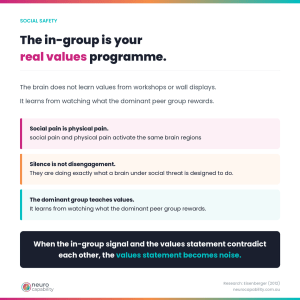
Naomi Eisenberger’s research at UCLA demonstrated that social pain and physical pain activate the same brain regions. The neural alarm that fires when you break a bone is the same one that fires when you risk social exclusion. When your brain weighs up whether to challenge the dominant group, it is not running a cost-benefit analysis. It is running a threat response, and it cannot distinguish between “this idea might be unpopular” and “I might lose my place in this group.”
When you picture the person sitting across from you who can see the values are not being lived, who has watched the dominant group reward a very different set of behaviours and quietly chosen silence, understand that they are not disengaged. They are doing exactly what a brain under social threat is designed to do.
This is why so many values programmes fail. We have watched multiple large organisations face public exposure for cultures that bore no resemblance to their stated values. The gap between what was on the wall and what was tolerated behind closed doors was not a communication failure. It was a dominant group signal that everyone had learned to read.
The brain does not learn values from workshops or wall displays. It learns from watching what the dominant peer group rewards, and it updates at a neural level, not just a behavioural one. When the in-group signal and the values statement contradict each other, the values statement becomes noise.
This sits at the heart of Social Safety, which I define as an individual’s perception that they are safe to engage in interpersonal risk-taking (Ray, 2021). Not psychological safety as an organisational metric, but social safety as a felt human experience. The sense that speaking up will not cost you belonging. Where that is absent, the dominant group’s values win, not because people are weak, but because their brains are working as they were built to.
What would it take for the people around you to feel genuinely safe to challenge what is actually being rewarded?
#NeuroscienceOfLeadership #SocialSafety #PsychologicalSafety #OrganisationalCulture #LeadershipDevelopment