
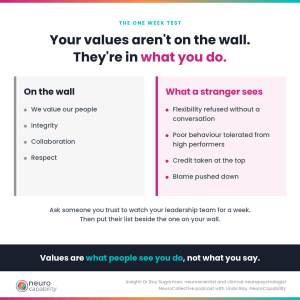
 Your organisation’s values are not on the wall.
They are whatever a stranger would write down after watching your leaders for one week.
That is how neuroscientist and clinical neuropsychologist Dr Roy Sugarman puts it to the executives he works with. He tells them he will watch how they operate for a week and then tell them what their values are. They are often shocked by the answer.
I recognise that moment. For years I have walked into organisations and asked about their purpose and values, and the reply is so often “it’s written down somewhere, we’ll find it” or a nod towards a poster on the wall. Then I watch what happens in practice, and the gap is enormous.
Recently I looked through people and culture roles advertised on Seek. Many promised a fantastic culture driven by strong values. Then I read the employee reviews for those same organisations, and the two rarely described the same place.
WE HAVE BEEN TAUGHT THE WRONG MODEL
The leadership industry treats values as something you write. Run the workshop, agree on the words, print the poster, launch the campaign.
However, our people don’t experience values as words. They experience them as decisions. Who gets promoted. What gets tolerated from a high performer. Who gets the credit when things go well, and who gets the blame when they don’t.
Roy offered one reason the gap persists. We believe what comes out of our own mouths far more than what comes out of anyone else’s. Say the values often enough and leaders start to believe they are living them.
NOW SEE IT FROM THEIR SIDE
Picture the most capable person in your team sitting in your next all staff meeting while “we value our people” goes up on the screen. Now picture them remembering last Tuesday, when their request for flexibility was knocked back without a conversation.
Their brain gives far more weight to what they have lived than to what is on the slide. And when stated and lived values don’t match, people stop feeling that their work is valid or authentic.
Roy sees the result in his consulting rooms. People who were thriving, until the values shifted around them. Many never say why. They simply leave, and the organisation calls it natural churn.
THE ONE WEEK TEST
Before your next values conversation, ask someone you trust to watch how your leadership team actually operates for a week. Then have them write down the five values they saw. Not the ones you hoped they would see.
Put that list beside the one on your wall.
If a stranger shadowed your leadership team for a week, which value on your wall would they struggle to find?
#Leadership #OrganisationalCulture #Values #PsychologicalSafety

One Response
Roy and I go much deeper into psychological flexibility, values and why so many organisations are still slow to act on the evidence in our NeuroCollective conversation. Listen or watch here: https://open.spotify.com/episode/3yljyENVEdH5T2WUCwi8CH?si=18r15eB3Tg6YzUF1BjYtHA